Rethinking recombination from first principles with AI-accelerated algorithm design
Instead of porting discrete tree searches or triplet loops to faster hardware, we formulated recombination as continuous motion across a metric reference map in linear $\mathcal{O}(NKL)$ time:
Embeds $K$ reference genomes on a metric map with a neutral center drain, tracking each sequence site-by-site via soft attention weights and an orthogonal ghost-donor axis.
Parent switches create equal-and-opposite attention dipoles across breakpoints, resolved across four orders of magnitude in tract length by dyadic wavelets and Viterbi decoding.
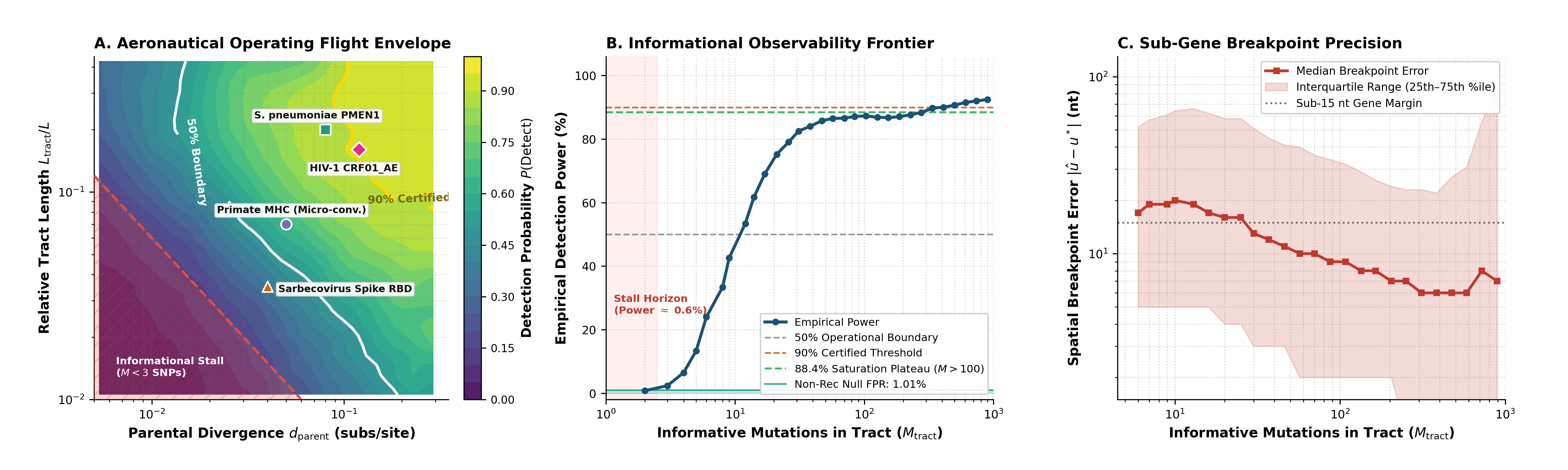
Scans 83 whole sarbecoviruses (31 kb) in 2.6s, 240 S. pneumoniae chromosomes (2.22 Mb) in 36.1s, and 379 primate MHC alleles in 1.1s.
Attention maps, force dipoles, and dyadic polishing in four steps
Places $K$ reference genomes on a map with a neutral drain at the center. Fast-mutating branches flow into the center drain instead of triggering false alarms.
At each site $u$, every sequence distributes attention weights over the landmarks. Unsampled ("ghost") donors lift the sequence along an orthogonal ghost axis $\mathbf{d}_{\mathrm{ghost}}$.
When a sequence jumps from Parent A to Parent B, Parent A's weight drops and Parent B's weight rises equally—creating a sharp force dipole ($\Delta \mathbf{w}_i$) tested against a Brownian bridge.
Wavelet filters with doubling widths ($2, 4, 8, 16\dots$ sites) catch both 80 bp and 30 kb swaps. Viterbi decoding and likelihood polishing lock in exact edges, scrub tracts, and merge clades.
Rate bursts, ancestral clades, ghost donors, and three-parent mosaics
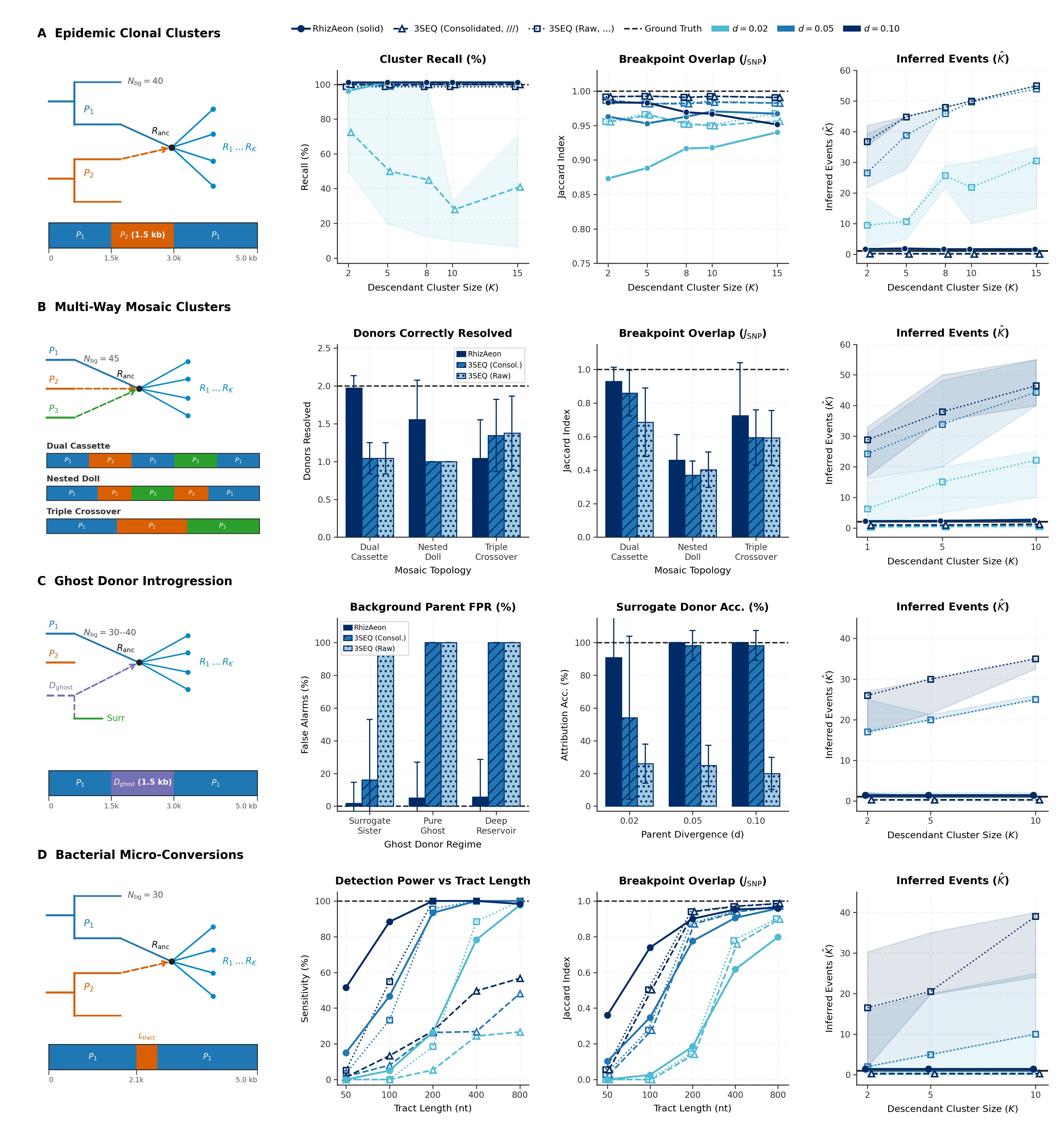
3SEQ.
(C–D) Orthogonal ghost projection finds extinct donors (89.2% F1) and three-parent mosaics (90.0% full parent recovery).
1.01% false-alarm rate and iterative scrubbing across 1,000,000 genomes
78–83 full sarbecovirus genomes mapped in 2.6 seconds (vs. 4.5 days in GARD)
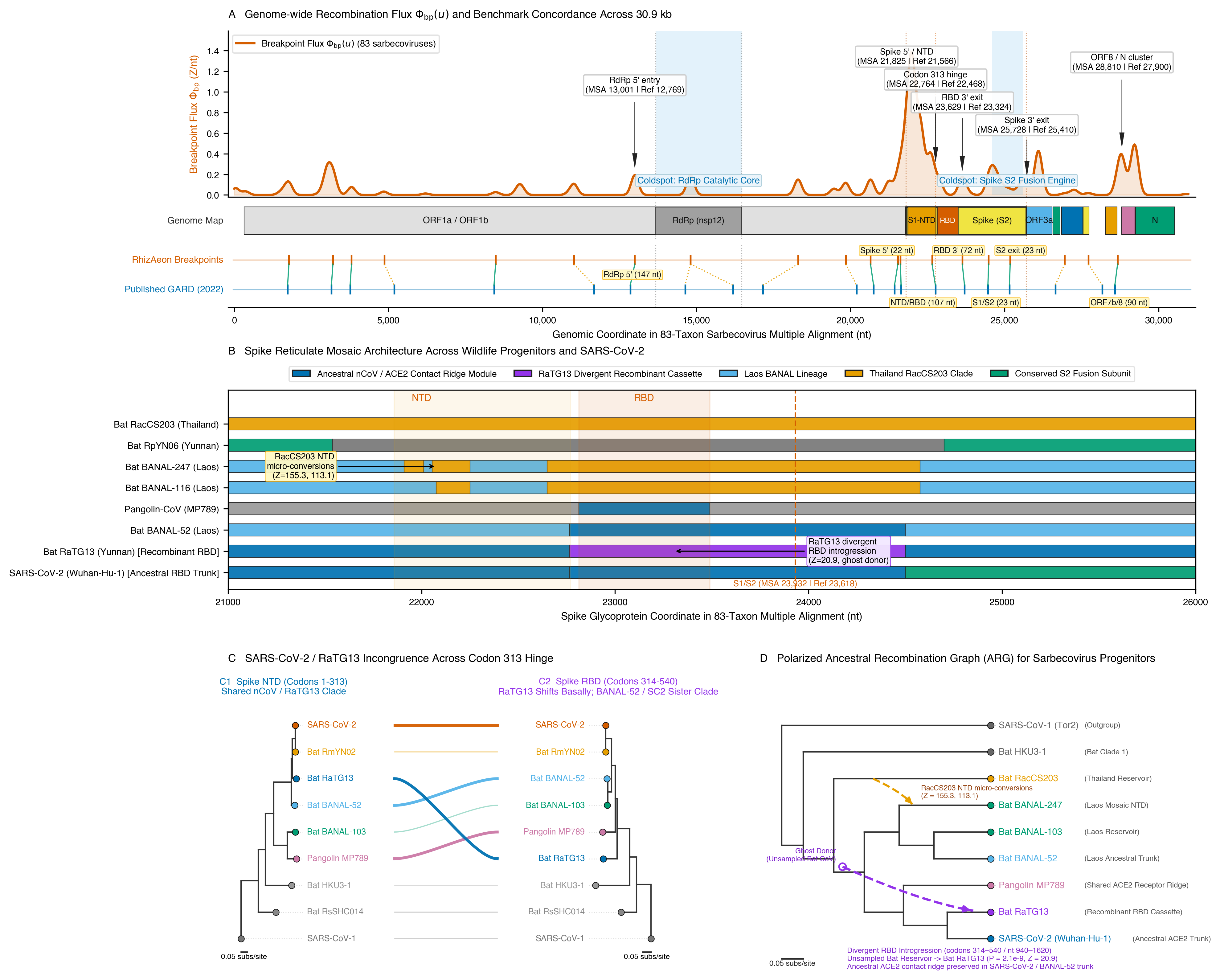
GARD breakpoints from Lytras et al. (2022) (median offset 99.0 nt; 9–12 nt at Spike NTD and S1/S2 junctions).
(C–D) Pinpoints the Laotian bat BANAL-20-52 / RaTG13 RBD exchange at a 60,000× speedup.
From 2.22 Mb pneumococcal chromosomes to 86 bp HLA micro-conversions
Maps 392 transfers across 240 chromosomes (~35× faster than Gubbins), finding the exact resistance swaps at pbp2x, pbp1a, pbp2b, folA, folP, and cps.
Dyadic wavelets catch 103 short Exon 2/3 pocket conversions, including the classic HLA-B*46:01 hybrid between B*15:01 and C*01:02.
Try the live app at veg.github.io/rhizaeon-code or grab the Rust/Python package at veg/rhizaeon-code.