Slide 1 of 6 · TRACE-5.0 in 60 Seconds
01 / The 60-Second Summary

How HIV-TRACE Learned to Stop Worrying and Love the Molecular Clock

Standard HIV-1 cluster detection uses flat genetic distance cutoffs (0.5% or 1.5%) that ignore when samples were collected. TRACE-5.0 adds the molecular clock to pairwise networks—without building phylogenetic trees.

2× Yield
More Future Cases Found

Nearly doubles follow-up diagnoses per prioritized patient (0.40 → 0.80 in DC) while cutting patient reviews by 61%.

-93% Noise
Fewer Non-Growing Clusters

83.3% of velocity-prioritized clusters grow prospectively (cutting non-growing priority clusters from 28 to 2).

<10 Seconds
Runs Offline in Browser

Screens 5,000+ sequences locally in WebAssembly using existing HIV-TRACE FASTA and date files.

02 / The Problem with Flat Cutoffs

HIV Mutates Every Day. Static Thresholds Pretend Time Stands Still.

Applying the same genetic cutoff whether two patients were sampled on the same afternoon or four years apart causes two opposite failures at once:

0.5% Cutoff
Too Strict for Delayed Diagnoses

Normal viral evolution pushes linked partners above 0.5% within 1–3 years. In Washington, DC, a flat 0.5% line severs 38.8% (19/49) of true transmission dyads and misses 91% of future linked cases.

1.5% Cutoff
Chains Unlinked Cases & Lab Repeats

Two identical sequences sampled 4 years apart aren't an outbreak—they're a repeat blood draw or HXB2 lab contamination. A flat 1.5% cutoff chains 90 patients in DC, 332 in Tennessee, and 2,896 in Japan into giant clusters.
03 / Fix #1 · Pairwise Scale (DANNO)

Replace the Flat Line with a Time-Aware Transmission Corridor

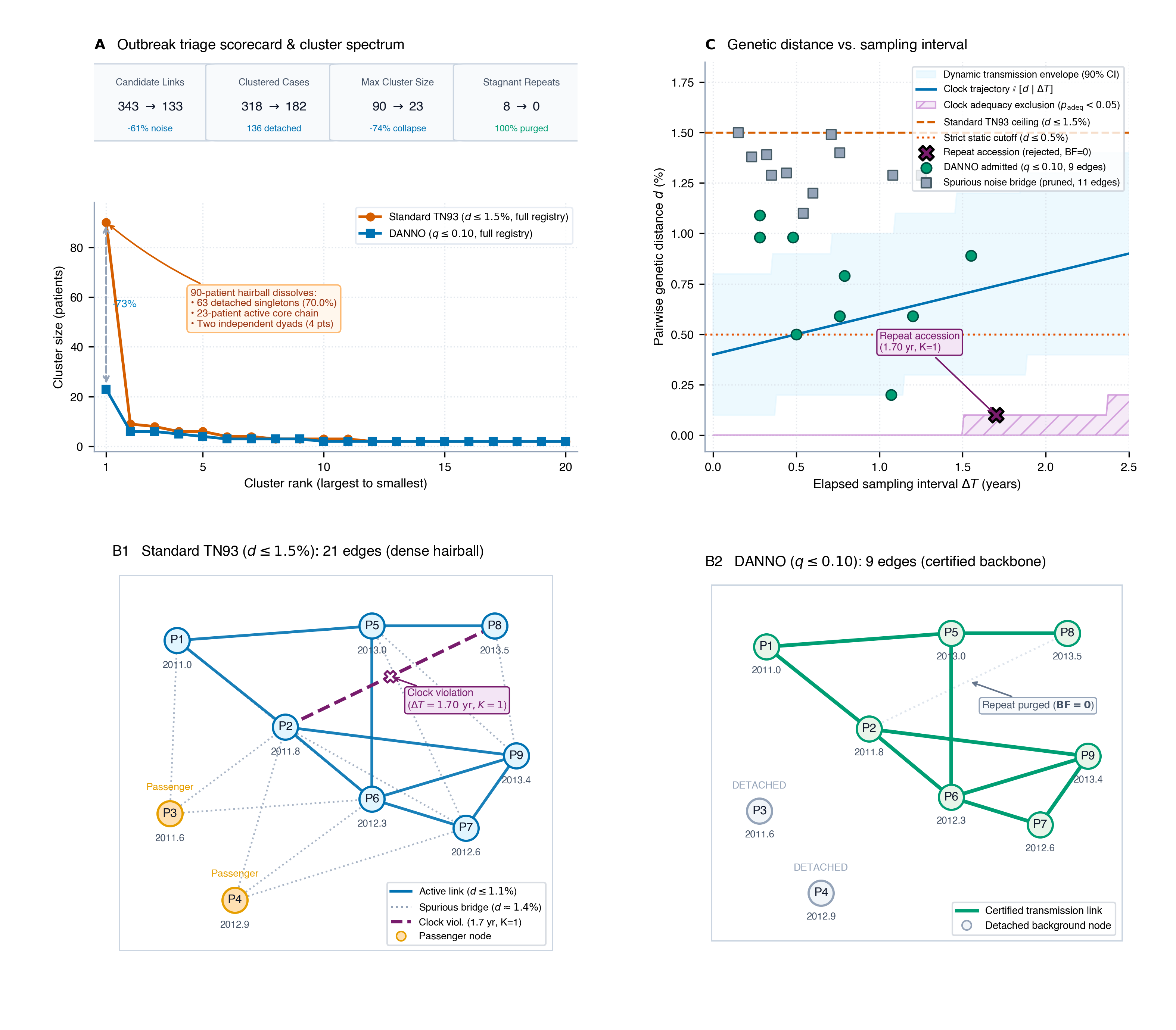
  • Expands with Sampling Lag (ΔT) Retains genuine partners diagnosed 1–3 years apart without opening the door to unlinked chronic background pairs.
  • Purges Lab Repeats Automatically Flags pairs with too few mutations for the years elapsed between them—catching duplicate patient samples and HXB2 carryover before review.
  • Collapses Giant Clusters by 74% Breaks DC's 90-patient cluster into a 23-patient active core and cuts prioritized patient investigations by 61.4%.
DANNO network deconstruction in Washington, DC
Washington, DC (N = 1,658): Static 1.5% (orange) vs. DANNO (blue).
04 / Fix #2 · Cluster Scale (STEVE)

Prioritize Clusters by Evolutionary Speed, Not Just Size

  • Active Outbreaks Evolve Fast Early HIV-1 infection replicates rapidly before purifying selection prunes variants, producing a steep clock slope (~15×10⁻³ sub/site/yr).
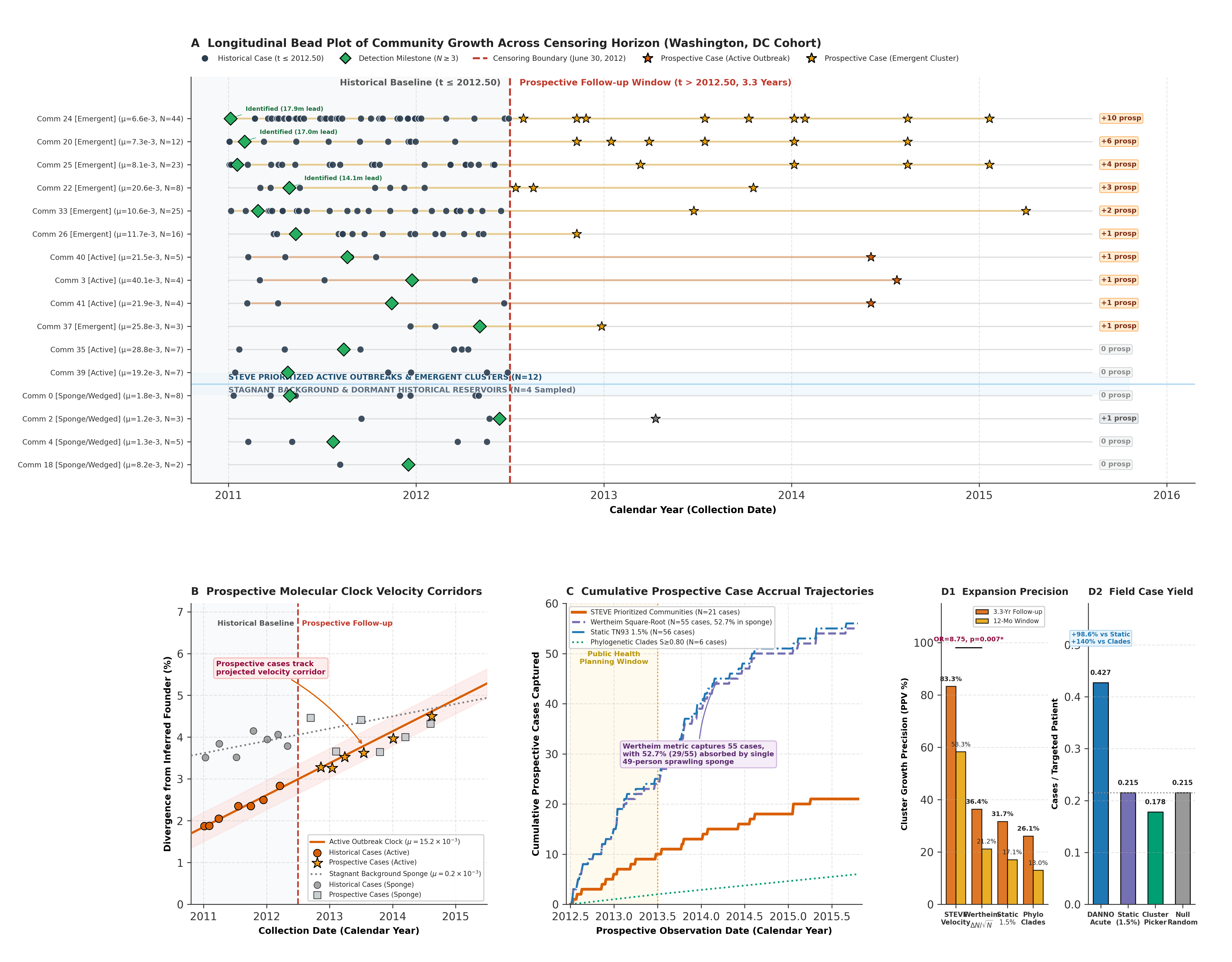
  • 83.3% Prospective Precision In temporal-holdout testing across DC, Tennessee, Japan, and Shenzhen, 75–83% of STEVE-prioritized clusters grew—cutting non-growing priority clusters by 92.9% (28 → 2 in DC).
  • Aligns Clusters with Services Tier 1/2 high-velocity clusters → expedited partner services & PrEP. Tier 3 chronic clusters → care re-engagement & viral suppression.
STEVE prospective validation in Washington, DC
10 of 12 STEVE priority clusters expand during follow-up (83.3% PPV).
05 / Fix #3 · Population Scale (CHIN)

How Big Is the Undiagnosed Epidemic? Count the Network Collisions.

  • The Birthday Paradox of Surveillance Sampling one person scales linearly with coverage (ρ), but sampling both partners of a transmission link scales quadratically (ρ²).
  • No External Demographic Priors Needed From edge collision rates alone, CHIN estimates what fraction of the transmitting population has been sequenced.
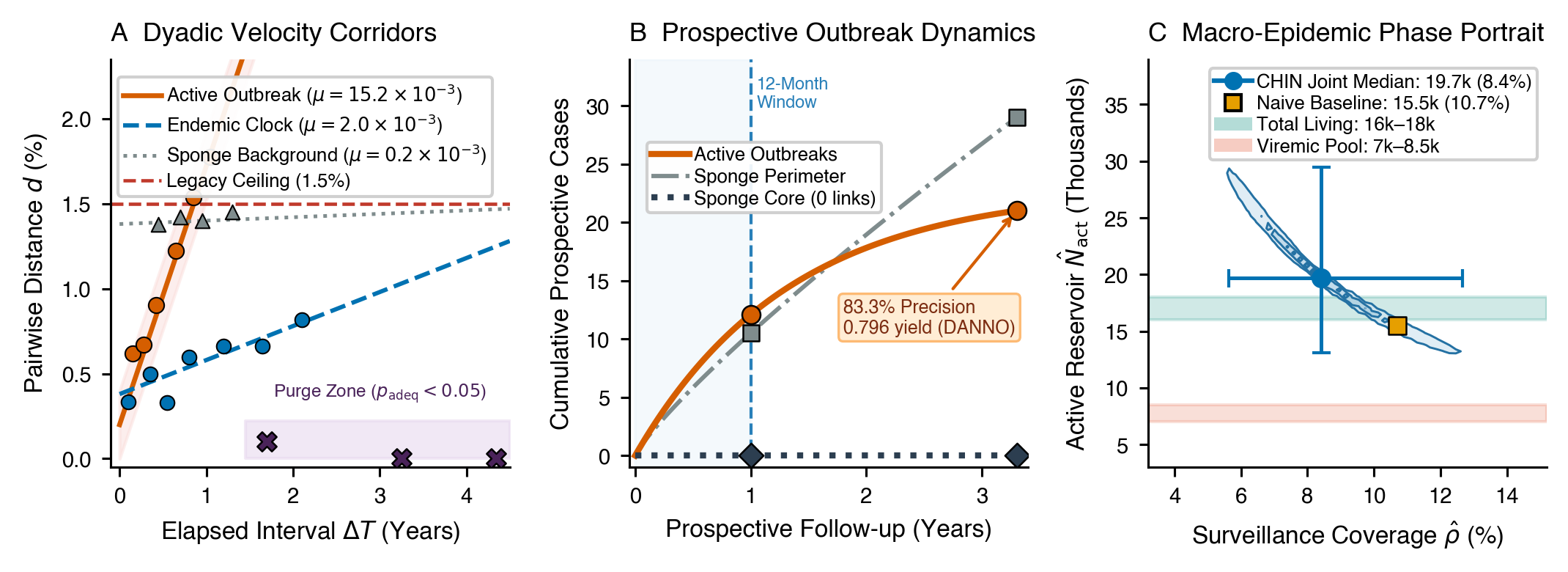
  • Matches Independent Benchmarks Across 4 Cohorts Recovers active pool sizes matching public health estimates in DC (19,700), Middle Tennessee (17,409), Japan (14,114), and Shenzhen (611).
Three-scale surveillance synthesis in Washington, DC
Three-scale surveillance (DANNO + STEVE + CHIN) across 10,259 patients.
06 / Practical Deployment for Health Departments

Drop-In Compatible with Existing HIV-TRACE Workflows

Built in Rust and compiled to both command-line binaries (trace50-cli) and client-side WebAssembly (trace50-wasm).

Same Files
Zero Workflow Disruption

Accepts the exact FASTA sequence and diagnosis-date files already exported for routine 0.5% / 1.5% reporting.

100% Local
Inside the Firewall

Executes entirely in browser memory with no internet connection—clinical sequences never leave the agency.

Try It Now
Open Source & Preprint

Preprint (Zenodo) ↗
Code (GitHub) ↗
3-Min Blog Post ↗